New Data Shows More Than Four in Five Kent County Young People Are Missing Out on Afterschool Programs

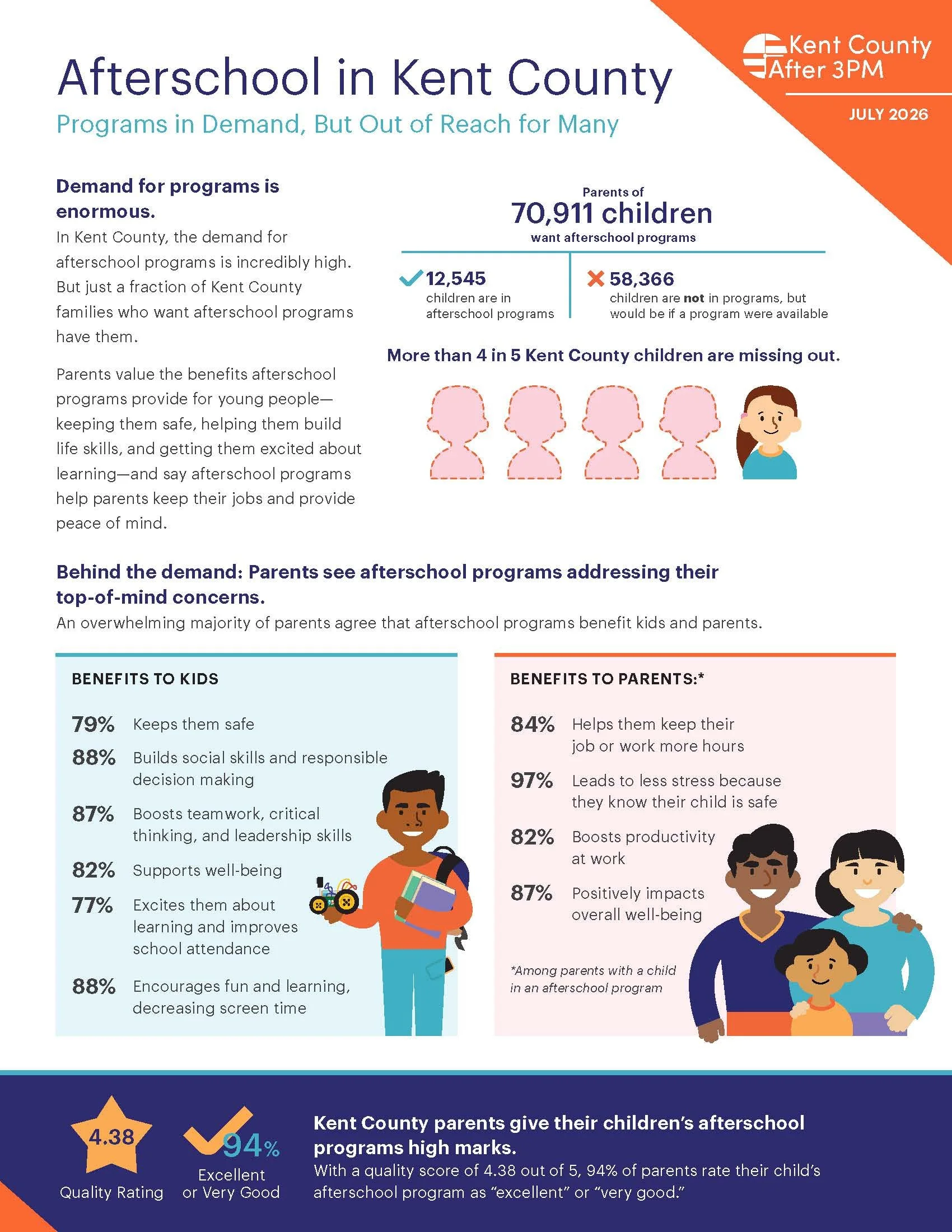
New Kent County-specific data from America After 3PM shows that families across the county see tremendous value in afterschool programs, but most young people whose families want these opportunities are still unable to access them.

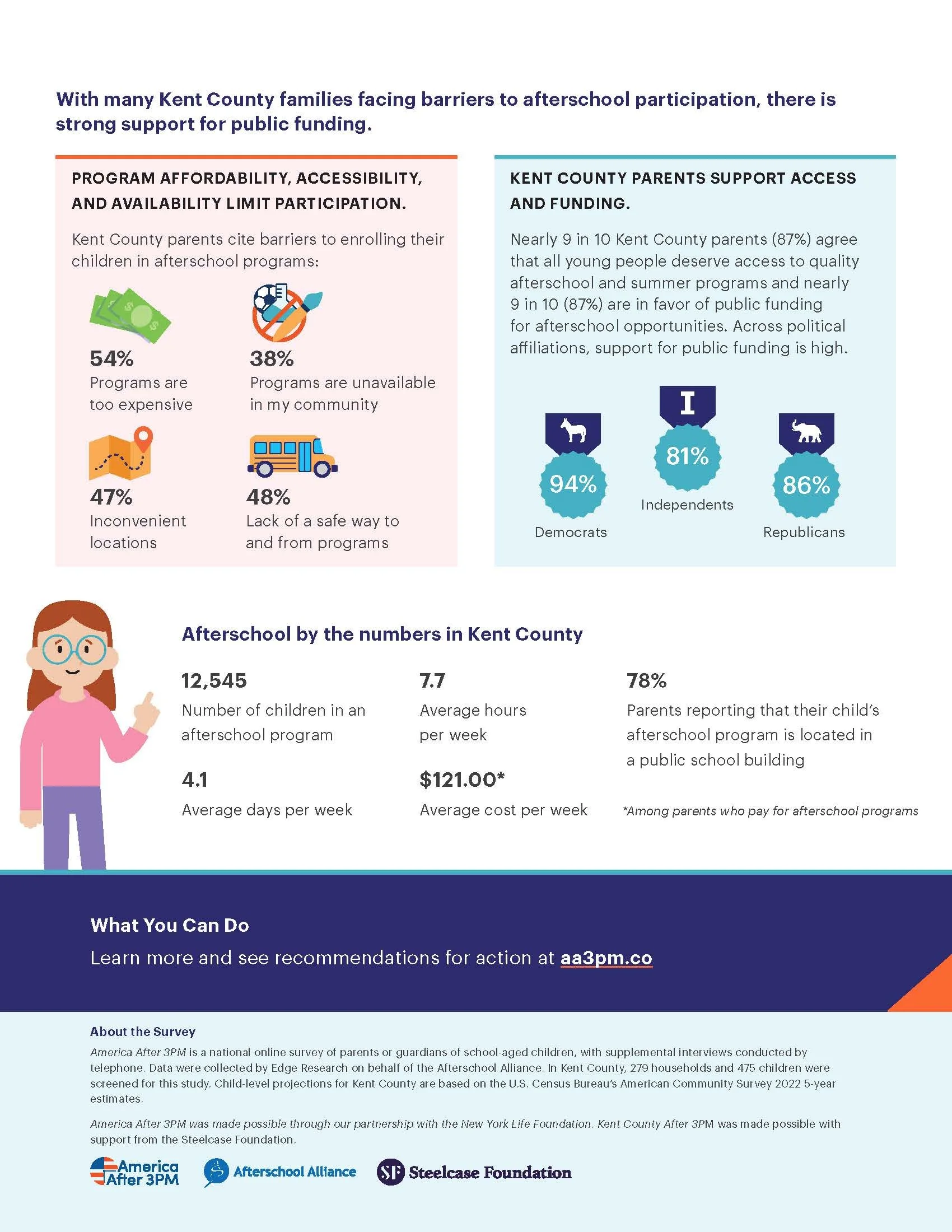
Parents of 70,911 Kent County young people want an afterschool program for their family. Only 12,545 are currently enrolled, leaving 58,366 young people who would participate if a program were available.

That means more than four out of every five Kent County young people whose parents want afterschool opportunities are missing out.

Kent County Families See the Benefits of Afterschool

Kent County parents overwhelmingly recognize the important role afterschool programs play in supporting young people’s safety, learning, development, and well-being.

Among Kent County parents surveyed:

  • 88% said programs build social skills and responsible decision-making.

  • 88% said programs encourage fun and learning while reducing screen time.

  • 87% said programs strengthen teamwork, critical thinking, and leadership skills.

  • 82% said programs support young people’s well-being.

  • 79% said programs help keep young people safe.

  • 77% said programs increase excitement about learning and improve school attendance.

The benefits also extend to parents and caregivers. Among Kent County parents with a young person enrolled in an afterschool program, 97% said they experienced less stress because they knew their young person was safe.

Another 87% said programs positively affected their overall well-being, while 84% said access helped them keep their job or work more hours. Eighty-two percent said afterschool programs improved their productivity at work.

Kent County families also gave their programs high marks. Ninety-four percent of parents rated their young person’s afterschool program as “excellent” or “very good,” resulting in an overall quality score of 4.38 out of 5.

Cost, Transportation, and Location Limit Access

Although families clearly value afterschool programs, affordability, transportation, location, and availability continue to create barriers.

Kent County parents identified several common challenges:

  • 54% said programs were too expensive.

  • 48% reported not having a safe way to travel to and from programs.

  • 47% said programs were located in inconvenient locations.

  • 38% said programs were unavailable in their community.

Among parents who pay for afterschool programs, the average weekly cost was $121. Young people enrolled in programs attended an average of 4.1 days per week for approximately 7.7 hours each week.

These findings show that the access gap is not caused by a lack of interest. Families want afterschool opportunities, but too often they cannot find programs that are affordable, nearby, available, or accessible through safe and reliable transportation.

Kent County Parents Support Public Investment

Kent County parents also expressed strong support for expanding access to afterschool and summer programs.

Nearly nine in 10 parents, or 87%, agreed that all young people deserve access to quality afterschool and summer opportunities. The same percentage supported public funding for afterschool programs.

Support remained strong across political affiliations:

  • 94% of Democrats

  • 81% of Independents

  • 86% of Republicans

This broad support reflects a shared understanding that afterschool programs strengthen young people, families, workplaces, and communities.

Kent County Must Meet the Demand

The new America After 3PM findings present a clear call to action.

Kent County families want afterschool programs, value their impact, and support public investment to expand them. Yet more than 58,000 young people remain without access to a program their families would use.

Closing that gap will require sustained funding, expanded program capacity, affordable participation options, and stronger transportation solutions throughout the county.

High-quality out-of-school time programs give young people safe places to learn, build relationships, explore their interests, and feel connected to their communities. Kent County families have made the need clear. Now is the time to ensure those opportunities are within reach.

America After 3PM is a national survey of parents and guardians of school-aged young people conducted by Edge Research on behalf of the Afterschool Alliance. The Kent County findings are based on 279 households and 475 young people screened for the study. Child-level projections are based on the U.S. Census Bureau’s American Community Survey 2022 five-year estimates.

Historic $135 Million for Afterschool and Summer Programming in Michigan's FY27 Budget

Historic $135 Million for Afterschool and Summer Programming in Michigan's FY27 Budget

Michigan's FY27 state budget includes a historic $135 million appropriation for afterschool and summer programming — a major win for young people and families across the state.

This funding reflects sustained, bipartisan support from the Governor and Legislature, including Governor Whitmer, Speaker Hall, and Majority Leader Brinks, along with lawmakers on both sides of the aisle who engaged thoughtfully with our field throughout this year's budget process. This year's budget required difficult decisions, but one thing has been clear throughout: support for Michigan's children and families is bipartisan.

New Data Shows Two in Three Michigan Young People Are Missing Out on Summer Programs

New summer findings from America After 3PM show that Michigan families want structured summer opportunities for their young people, but far too many are unable to access them.

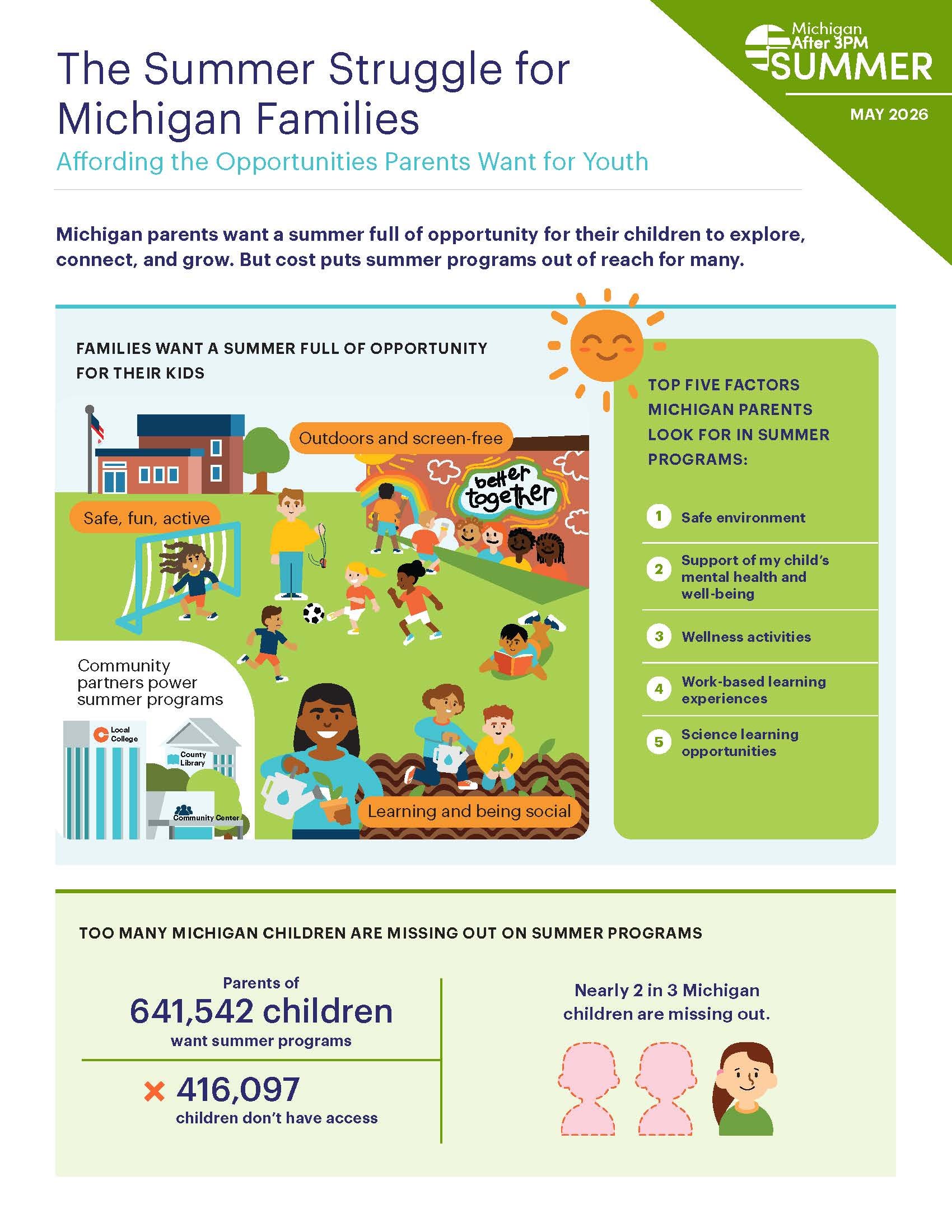
Parents of 641,542 Michigan young people want a structured summer program for their family. Only 225,445 are currently enrolled, meaning approximately 416,000 young people are missing out.

That means two out of every three Michigan young people whose parents want a summer program are unable to participate, most often because of cost.

Families Want Safe, Supportive Summer Opportunities

Structured summer programs include enrichment and sports programs, summer camps, summer school, jobs, and internships. These experiences offer young people safe places to spend their time, stay active, build relationships, continue learning, and explore their interests while school is out.

Michigan parents said the factors they value most when choosing a summer program include:

  • A safe environment

  • Support for mental health and well-being

  • Opportunities for physical activity and wellness

For working families, these programs also provide peace of mind that young people are safe, engaged, and supported during the summer months.

“The Summer Struggle for Michigan Families is a sobering reminder that too many working families scramble to find summer programs for their children,” said Erin Skene-Pratt, Executive Director of the Michigan Afterschool Partnership. “It shouldn’t be this difficult for families to access summer programs that will help their children engage, be active, and learn over the summer. We are working with a great team of local and state policymakers, funders, and community partners to tackle this problem and help ensure that every Michigan family can access the summer options they deserve.”

Cost Is the Most Common Barrier

Although demand for summer programming is high, affordability remains the largest obstacle for Michigan families.

Among parents who were unable to enroll their young person:

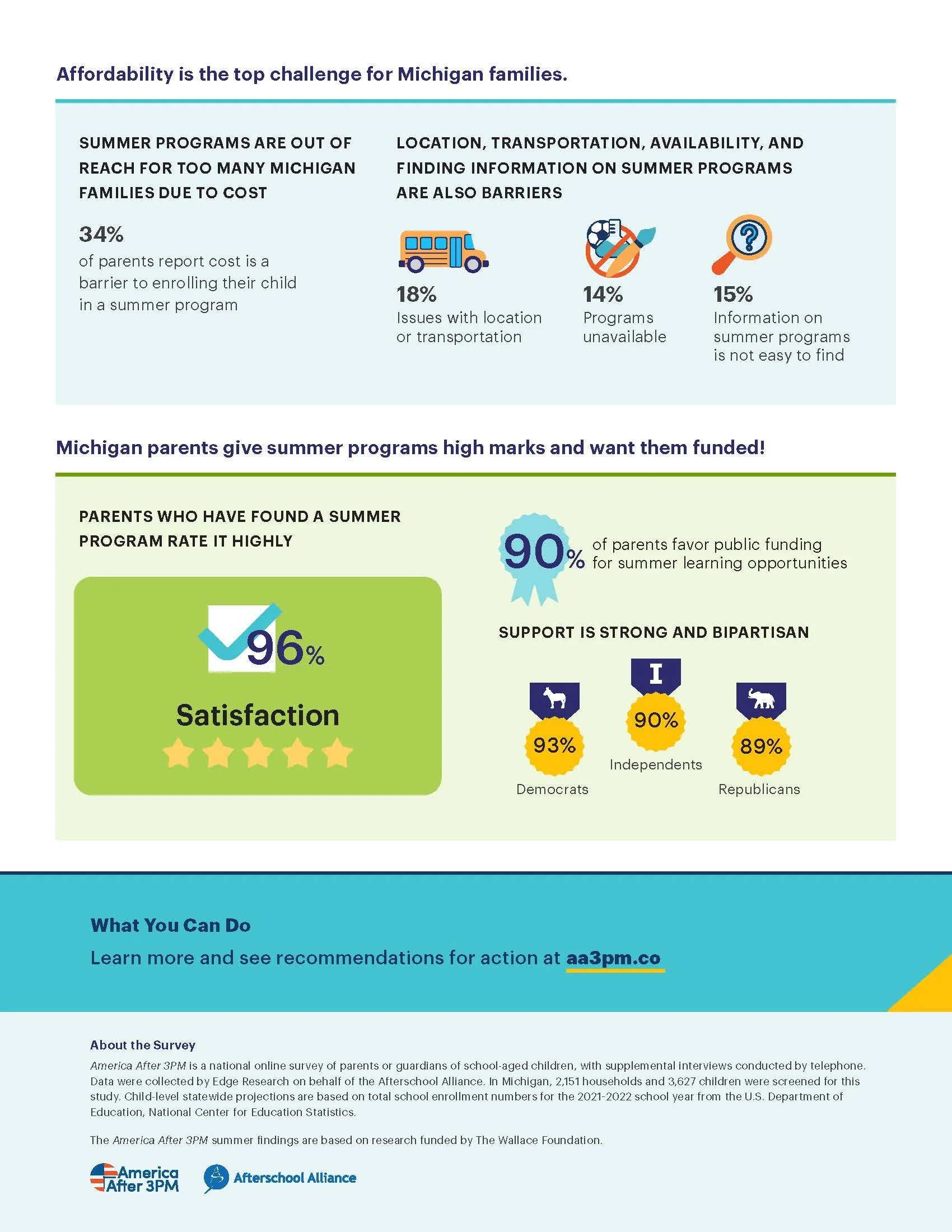
  • 34% cited cost as a barrier.

  • 18% cited program location or transportation challenges.

  • 14% said programs were unavailable.

These barriers can force families to piece together care, adjust work schedules, rely on limited informal options, or go without summer programming entirely.

The findings show that the summer access gap is not caused by a lack of interest. Families want these opportunities, but many cannot find programs that are affordable, nearby, available, or accessible through reliable transportation.

Parents Give Summer Programs High Marks

Families who are able to access summer programs report overwhelmingly positive experiences.

In Michigan, 96% of parents with a young person enrolled said they were satisfied with the program they attended.

Nationally, the findings also showed that parents with a young person enrolled in a summer program were more likely to feel extremely confident that their young person would be prepared for the upcoming school year.

Summer programs are not simply a way to fill time while school is out. They can help young people stay connected, reduce isolation, remain physically active, strengthen academic skills, and return to school ready for the year ahead.

Strong Support for Public Investment

Michigan parents overwhelmingly support public funding to expand access to summer opportunities.

Nine out of 10 Michigan parents, or 90%, said they support public funding for summer programs. That support crossed political affiliations:

  • 93% of Democrats

  • 90% of Independents

  • 89% of Republicans

The broad support reflects the value families place on summer programs and the understanding that access should not depend on a family’s income, ZIP code, transportation options, or ability to navigate limited program availability.

Michigan Must Close the Summer Access Gap

The new America After 3PM summer findings provide a clear call to action.

Michigan families want high-quality summer opportunities for their young people. They value the safety, learning, wellness, connection, and stability these programs provide. Yet hundreds of thousands of young people remain unable to participate.

Closing that gap will require sustained public investment, stronger transportation solutions, increased program capacity, and affordable options in communities across the state.

Every young person deserves access to a safe and supportive place to learn, grow, connect, and belong during the summer. Michigan families have made the demand clear. Now, our state must work together to ensure those opportunities are within reach.

The summer findings are part of the America After 3PM series of household surveys conducted by Edge Research on behalf of the Afterschool Alliance. The Michigan findings are based on responses from 2,151 parents of school-aged young people. Data were collected between January 31 and April 21, 2025. The America After 3PM summer research was funded by The Wallace Foundation.

Where Michigan's Afterschool Funding Stands: Section 32n and 21st CCLC Update

Michigan families navigating afterschool and summer programming options are watching two critical funding streams right now — one at the state level and one federal. The news on both fronts is largely positive, but the road to get here has been anything but smooth, and the work of protecting these investments is far from over.

Section 32n: Michigan Looks to Hold the Line

Michigan's Section 32n out-of-school time (OST) grant program has become one of the most significant state-level afterschool investments in the country, and the current budget cycle reflects continued momentum.

The Governor and Senate have proposed a total of $135 million for Section 32n in 2026-27, combining $85 million in one-time School Aid Pupil Support Fund dollars with $50 million in ongoing State Aid Fund support — a significant signal that state leadership views OST not as a one-time investment but as a permanent fixture of Michigan's education infrastructure.

The Michigan House is also working to address the demand for OST in Michigan, maintaining its previous level of investment in the face of anticipated revenue reductions. With the May Consensus Revenue Estimating Conference showing higher than expected revenues, House leaders are engaging in renewed conversations about FY27 funding opportunities.

There are numerous opportunities for afterschool and summer learning supporters to engage in the coming weeks, as the budget is being completed. Whether you can do a complete legislative site visit at your local OST program or even just click to send an instant message, your voice is needed!

Federal Appropriations Watch: 21st CCLC Funding on the Line Again

The next chapter in the fight for federal afterschool funding is playing out this week. The House Labor-HHS-Education Appropriations Subcommittee is scheduled to mark up its FY2027 spending bill on June 5 — and that bill will determine funding for all education, childcare, and AmeriCorps programs, including 21st Century Community Learning Centers. Whatever passes will support students during summer 2027 and throughout the 2027-28 school year.

The good news is that the bill is not expected to mirror the President's FY2027 budget proposal, which would have eliminated 21st CCLC entirely and folded it along with 16 other programs into a block grant. Congress has rejected that approach before, and early signals suggest they will do so again. Still, the markup bears watching. MASP will continue to track the legislation and share updates as they develop.

What This Means for Michigan Programs

Michigan OST providers are in a relatively stronger position than most states heading into the next program year, thanks to the combination of robust Section 32n investment and a sustained federal commitment from Congress. But the volatility at the federal level is real, and programs that rely on 21st CCLC cannot afford to treat continued funding as a given. The lesson of 2025 — when appropriated dollars were withheld mid-summer — is that authorization alone is not protection.

MASP will continue to monitor both funding streams and provide updates as the Michigan budget process and federal appropriations cycle develop. If you have questions about how these funding changes affect your program, reach out to our team.

New Data Shows Major Unmet Demand for Afterschool Programs in Detroit

New Detroit-specific data from America After 3PM shows that families across the city see tremendous value in afterschool programs, but most young people whose families want these opportunities are still unable to access them.

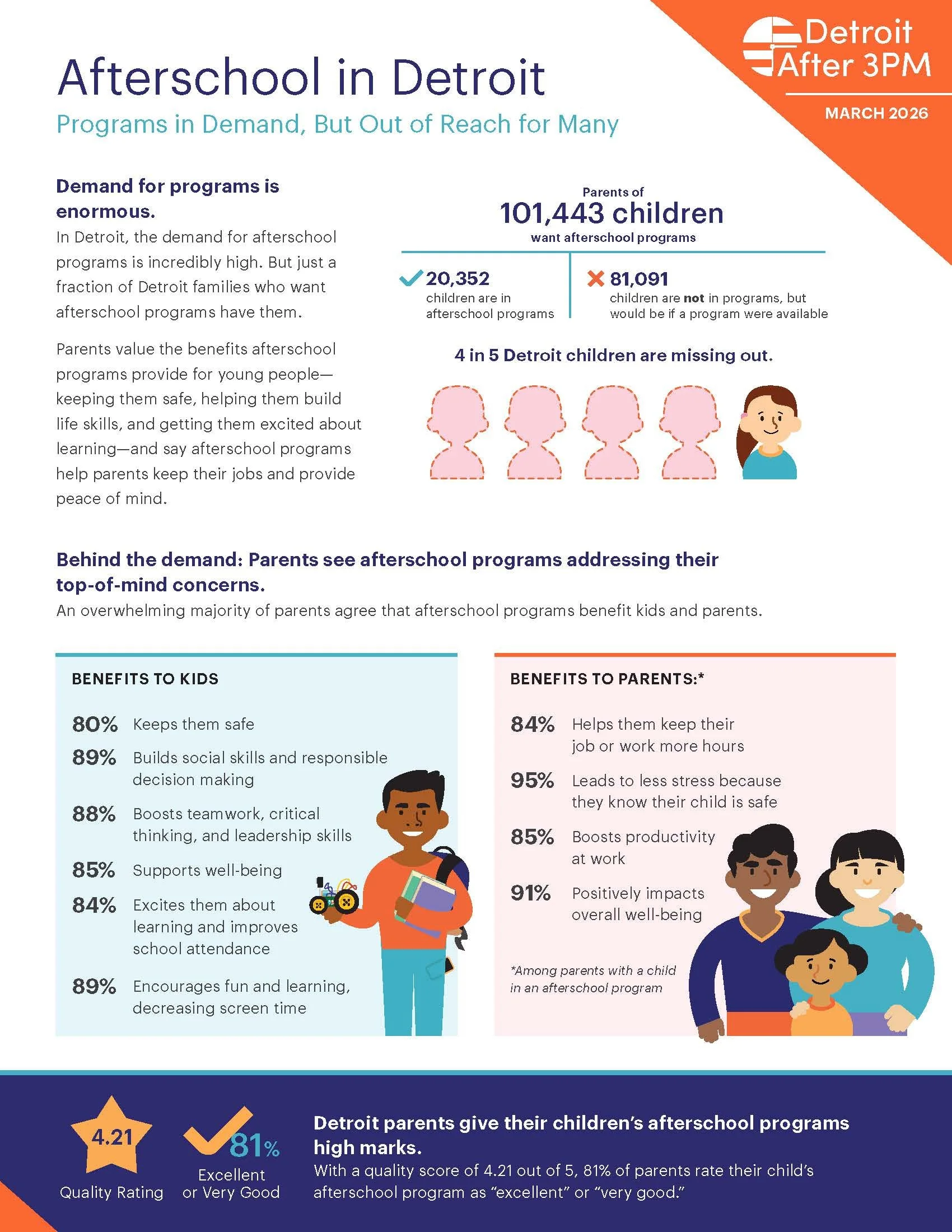
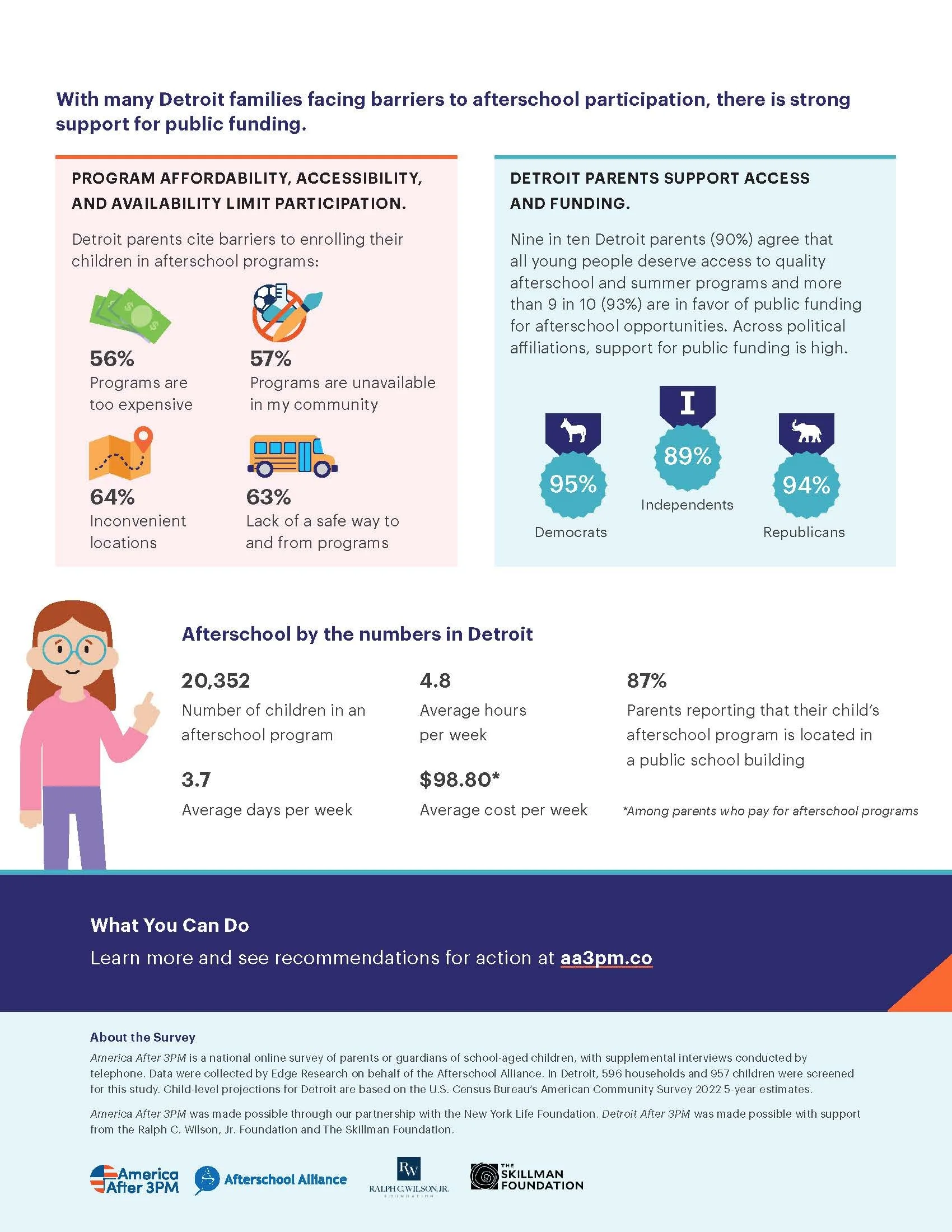
Parents of 101,443 Detroit young people want an afterschool program for their family. Only 20,352 are currently enrolled, leaving 81,091 young people who would participate if a program were available.

That means four out of every five Detroit young people whose parents want afterschool opportunities are missing out.

Detroit Families See the Benefits of Afterschool

Detroit parents overwhelmingly recognize the important role afterschool programs play in keeping young people safe, supporting their development, and helping them succeed in school and beyond.

Among Detroit parents surveyed:

  • 89% said programs build social skills and responsible decision-making.

  • 89% said programs encourage fun and learning while reducing screen time.

  • 88% said programs strengthen teamwork, critical thinking, and leadership skills.

  • 85% said programs support young people’s well-being.

  • 84% said programs increase excitement about learning and improve school attendance.

  • 80% said programs help keep young people safe.

The benefits extend to parents and caregivers as well. Among Detroit parents with a young person enrolled in an afterschool program, 95% said they experienced less stress because they knew their young person was safe. Another 91% said programs positively affected their overall well-being.

Eighty-five percent said access to afterschool programming increased their productivity at work, while 84% said it helped them keep their job or work more hours.

Detroit families also reported high satisfaction with the programs they use. Eighty-one percent of parents rated their young person’s afterschool program as “excellent” or “very good,” with programs receiving an overall quality score of 4.21 out of 5.

Affordability, Transportation, and Availability Remain Major Barriers

The demand for afterschool programs is clear, but Detroit families continue to encounter significant barriers to participation.

Parents identified several challenges:

  • 64% said programs were located in inconvenient locations.

  • 63% reported not having a safe way to travel to and from programs.

  • 57% said programs were unavailable in their community.

  • 56% said programs were too expensive.

Among parents who pay for afterschool programs, the average cost was $98.80 per week. Young people enrolled in programs participated an average of 3.7 days per week for approximately 4.8 hours each week.

The findings make clear that families are not choosing to go without afterschool opportunities. Too often, the programs they want are unavailable, unaffordable, difficult to reach, or disconnected from safe and reliable transportation.

Detroit Parents Strongly Support Public Investment

Detroit parents overwhelmingly believe every young person should have access to quality afterschool and summer opportunities.

Nine out of 10 parents, or 90%, agreed that all young people deserve access to these programs. Even more, 93%, supported public funding for afterschool opportunities.

Support remained high across political affiliations:

  • 95% of Democrats

  • 89% of Independents

  • 94% of Republicans

This broad agreement reflects a shared understanding that afterschool programs benefit more than the young people enrolled in them. They provide stability for families, support working parents, strengthen communities, and give young people safe places to learn, build relationships, and explore their interests.

Detroit’s Young People Deserve Greater Access

The newly released Detroit After 3PM data presents both a challenge and an opportunity.

Detroit families want afterschool programs, value their impact, and support public investment to expand them. Yet more than 81,000 young people remain without access to a program their families would use.

Addressing this gap will require sustained funding, expanded program capacity, affordable participation options, and stronger transportation solutions. It will also require listening to families and young people as programs are developed and expanded throughout the city.

High-quality out-of-school time programs help young people discover what is possible, develop skills, build trusted relationships, and feel connected to their communities. Detroit families have made their priorities clear. Now is the time to ensure that every young person can access the opportunities they deserve.

America After 3PM is a national survey of parents and guardians of school-aged young people conducted by Edge Research on behalf of the Afterschool Alliance. In Detroit, 596 households representing 957 young people were screened for the study. Detroit After 3PM was made possible with support from the Ralph C. Wilson, Jr. Foundation and The Skillman Foundation.

Celebrating Excellence in Michigan’s OST Field: 2026 Afterschool Excellence Awards

Each year, the Afterschool Excellence Awards shine a light on the people and partners who strengthen out-of-school time across Michigan. These awards recognize leadership, creativity, advocacy, and community-building that help young people feel a sense of belonging and access meaningful opportunities beyond the school day.

As we look ahead to the 2026 MAC Annual Conference, we invite you to help us celebrate the individuals and organizations who are shaping a brighter future for Michigan youth. Nominations are now open for five award categories, each honoring a unique contribution to the OST field.

Mary Sutton Leadership Award

This award honors a leader who embodies the legacy of Mary Sutton through bold vision, strong relationship-building, and a deep commitment to equitable access to out-of-school time. Nominees demonstrate exceptional leadership that strengthens Michigan’s OST ecosystem, uplifts youth and caregivers, and moves the field forward with clarity, compassion, and courage.

Impact Award

The Impact Award recognizes an individual or organization whose work has created measurable, meaningful change for youth in their community. Nominees show how high-quality OST programming, intentional partnerships, and youth-driven practices can transform opportunities, expand access, and support young people in pursuing their goals.

Rising Star Award

The Rising Star Award celebrates an emerging leader in the OST field who is already making a strong positive difference. Nominees bring creativity, dedication, and a learner’s mindset to their work. They demonstrate tremendous promise, a commitment to continuous improvement, and a passion for supporting youth voice and leadership.

Community Engagement Award

The Community Engagement Award recognizes someone who actively brings communities together to support youth. Nominees excel at building trust, fostering partnerships, and creating welcoming environments where youth, caregivers, educators, and community members feel valued and connected. Their work strengthens belonging and expands the reach and impact of OST programs.

OST Advocate of the Year Award

This award honors an individual who uses their voice, relationships, and influence to advance out-of-school time across Michigan. Nominees champion youth, mobilize partners, and strengthen public understanding and support for OST. Their advocacy helps ensure that every young person has access to safe, enriching opportunities beyond the school day.

Nominations are open now. We encourage educators, youth, caregivers, program leaders, policymakers, and community partners to lift up the leaders whose efforts deserve recognition. Award recipients will be celebrated at the 2026 MAC Annual Conference, held February 26–27 at the Suburban Collection Showplace in Novi.

Check out last year’s winners!

Supporting Families with SNAP & Local Food Assistance

Michigan has begun issuing full Supplemental Nutrition Assistance Program (SNAP) benefits again as of November 10. While the federal government remains shut down, the State of Michigan has taken steps to ensure families can continue to access food support.

Below are timely updates and resources that afterschool programs can share with caregivers.

SNAP Benefits Have Resumed

The Michigan Department of Health and Human Services (MDHHS) has directed its SNAP EBT vendor to resume full benefit issuance for all SNAP recipients in Michigan.

  • Families who normally receive their benefits on the 9th should see their full allotment within 48 hours.

  • All other SNAP recipients will receive full benefit payments on their normally scheduled date.

  • Recipients with monthly issuance on the 3rd, 5th, and 7th of the month already received benefits last week.

Caregivers with questions should contact their local MDHHS office or check MI Bridges for updates.

State Support During the Federal Shutdown

During the ongoing federal government shutdown, Governor Whitmer has announced $4.5 million in state funding to support the Food Bank Council of Michigan. This investment will:

  • Help feed families in all 83 counties.

  • Support food delivery for families who cannot drive to a food bank.

Michigan has also continued programs that help families access affordable food, including:

  • Double Up Food Bucks (matches SNAP dollars to buy fruits/vegetables).

  • Free breakfast and lunch for Michigan’s 1.4 million public school students.

Key Resources for Families

Connect Families with Michigan 2-1-1

Families can dial 2-1-1 or visit Find Help – Michigan 2-1-1 for free, confidential referrals to local food programs and other support services. This service operates statewide and can connect families to pantries, meal programs, and additional community resources.

Locate Local Food Banks

The Food Bank Council of Michigan provides a directory of regional food banks that distribute food to community pantries and meal programs. This is a good first step for families in urgent need of groceries or emergency food assistance.

Promote the Double Up Food Bucks Program

Michigan’s Double Up Food Bucks Program—supported by a grant administered by the Michigan Department of Agriculture and Rural Development (MDARD)—matches SNAP dollars spent on fresh fruits and vegetables. This allows families to stretch their food budgets while accessing healthier options. Families can find participating stores and farmers markets at doubleupfoodbucks.org.

Direct Families to Official SNAP Channels

For questions about SNAP eligibility, benefit status, or application assistance, families should contact their local MDHHS office or visit MI Bridges for online information and updates.

Stay Informed and Share Updates

The SNAP Outreach page at the Food Bank Council of Michigan provides updates, outreach materials, and partnership opportunities for organizations like yours.

Additional Resources

The Michigan Nonprofit Association’s SNAP Resources page also includes helpful information, guides, and downloadable materials for organizations that wish to expand food assistance outreach.

As trusted community partners, afterschool programs are uniquely positioned to ensure that families know how to access nutritious food and critical support. Please consider:

  • Including SNAP resource links in your newsletters, parent communications, and social media posts.

  • Training staff on how to refer families to 2-1-1 or local food banks.

  • Hosting information tables or distributing flyers about Double Up Food Bucks and MI Bridges.

Together, we can help ensure every Michigan child has the nutrition they need to learn, grow, and succeed.

Building Winning Applications for the 2025–26 OST Grant

Michigan is opening another exciting window of opportunity for out-of-school time (OST) partners dedicated to expanding access, belonging, and meaningful learning beyond the school day. The 2025–26 OST Grant application window is now open, and MASP is here to help you navigate the process with confidence.

We know that strong applications don’t just check boxes. They tell a compelling story about how young people grow when our communities invest in their holistic development. This year’s application is your chance to highlight the strengths of your program, elevate youth voice, and show how your work supports thriving families and local economies.

To support applicants, MASP has created a practical, step-by-step video guide: Building Winning Applications for the 2025–26 OST Grant in Michigan. Whether you’re applying for the first time or returning to build on past success, this walkthrough is designed to make the process more approachable.

The guide covers:
• How to navigate the application structure
• Tips for writing clear, impactful responses
• Ways to center youth experience and agency
• Budget and documentation considerations
• Strategies to elevate partnerships and community reach

The 2025–26 application window is open now. Full grant details, requirements, and deadlines can be found on MiLEAP’s Out-of-School Time webpage.

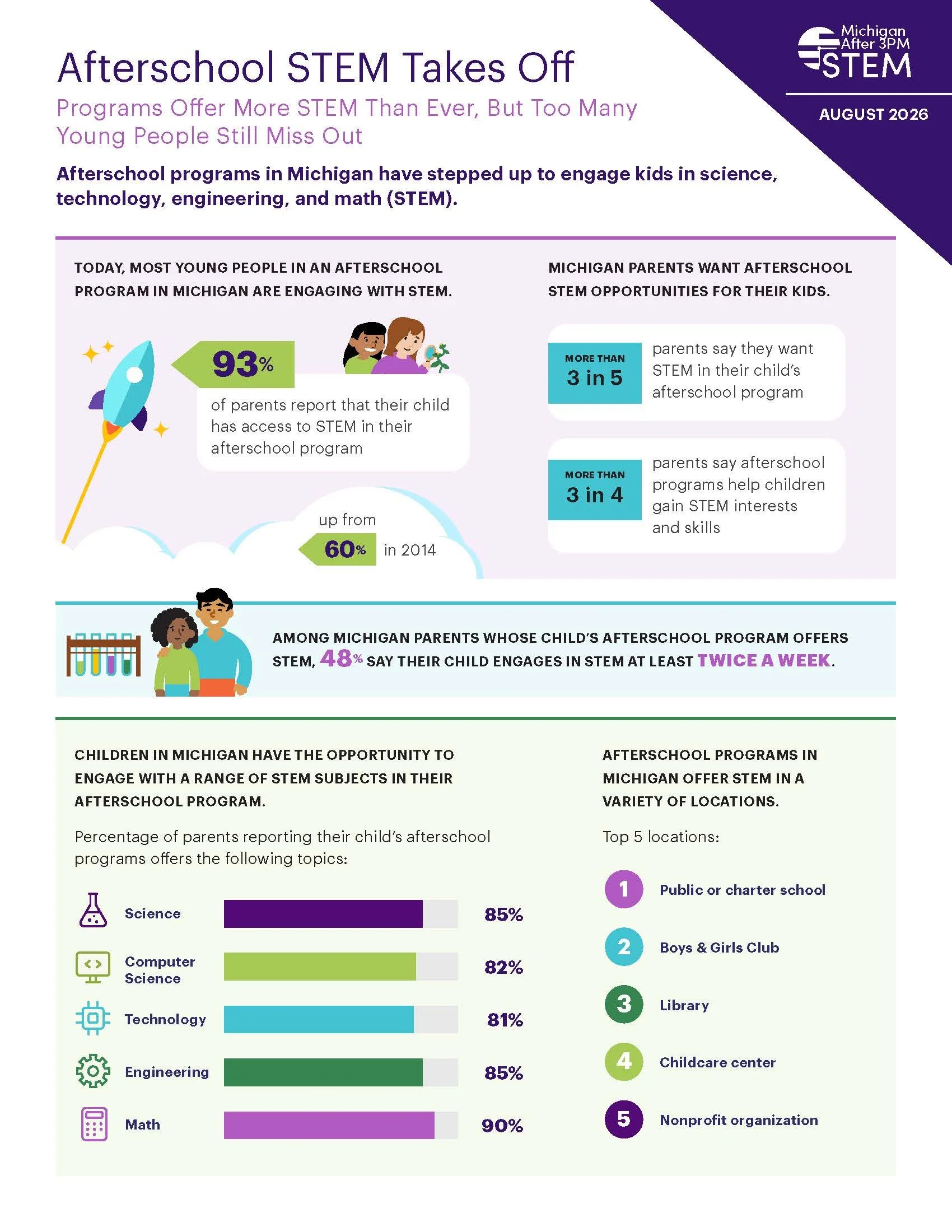
New Data Shows Enormous Demand for Afterschool Programs Across Michigan

A new statewide report released through America After 3PM confirms what families, providers, and communities across Michigan have long understood: families want afterschool programs, but far too many young people are unable to access them.

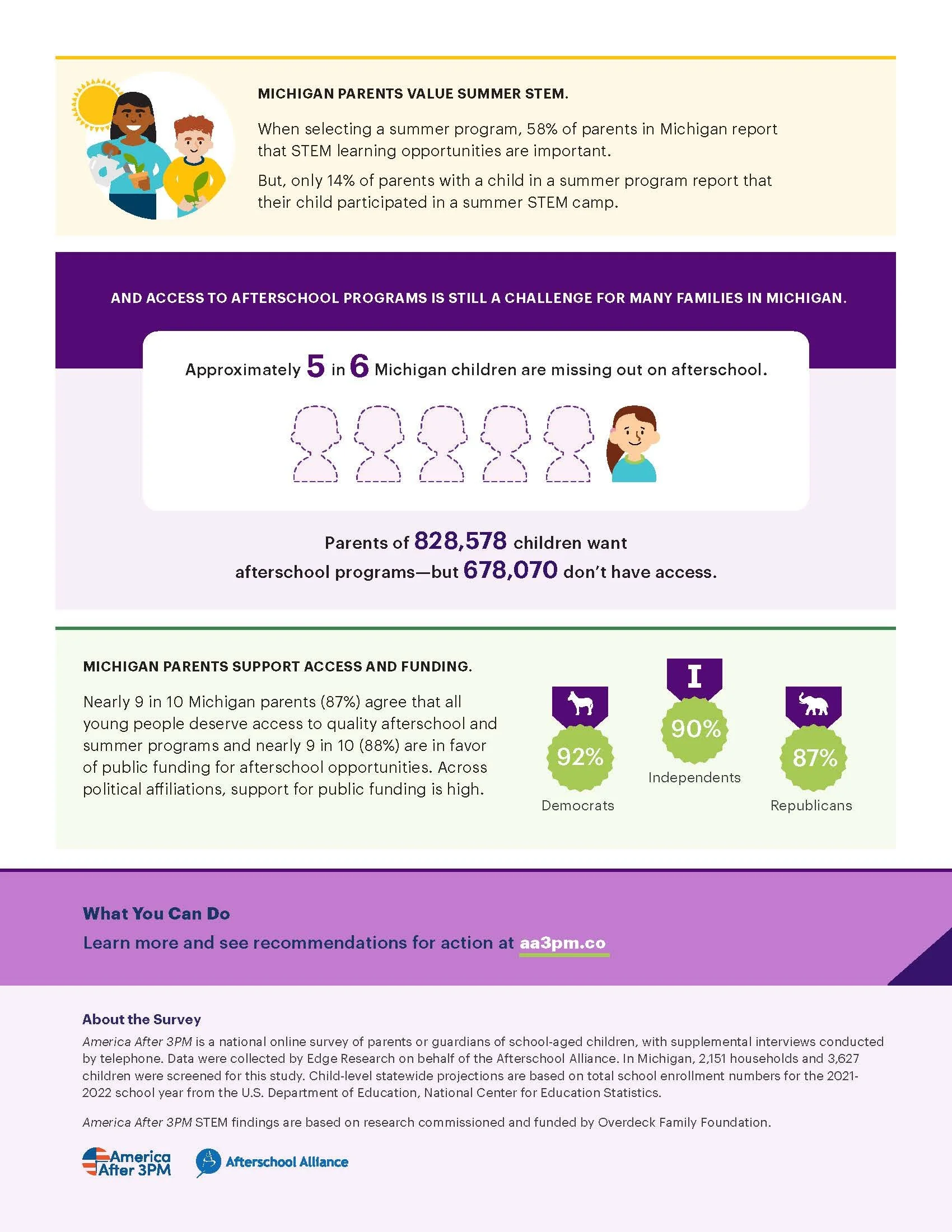
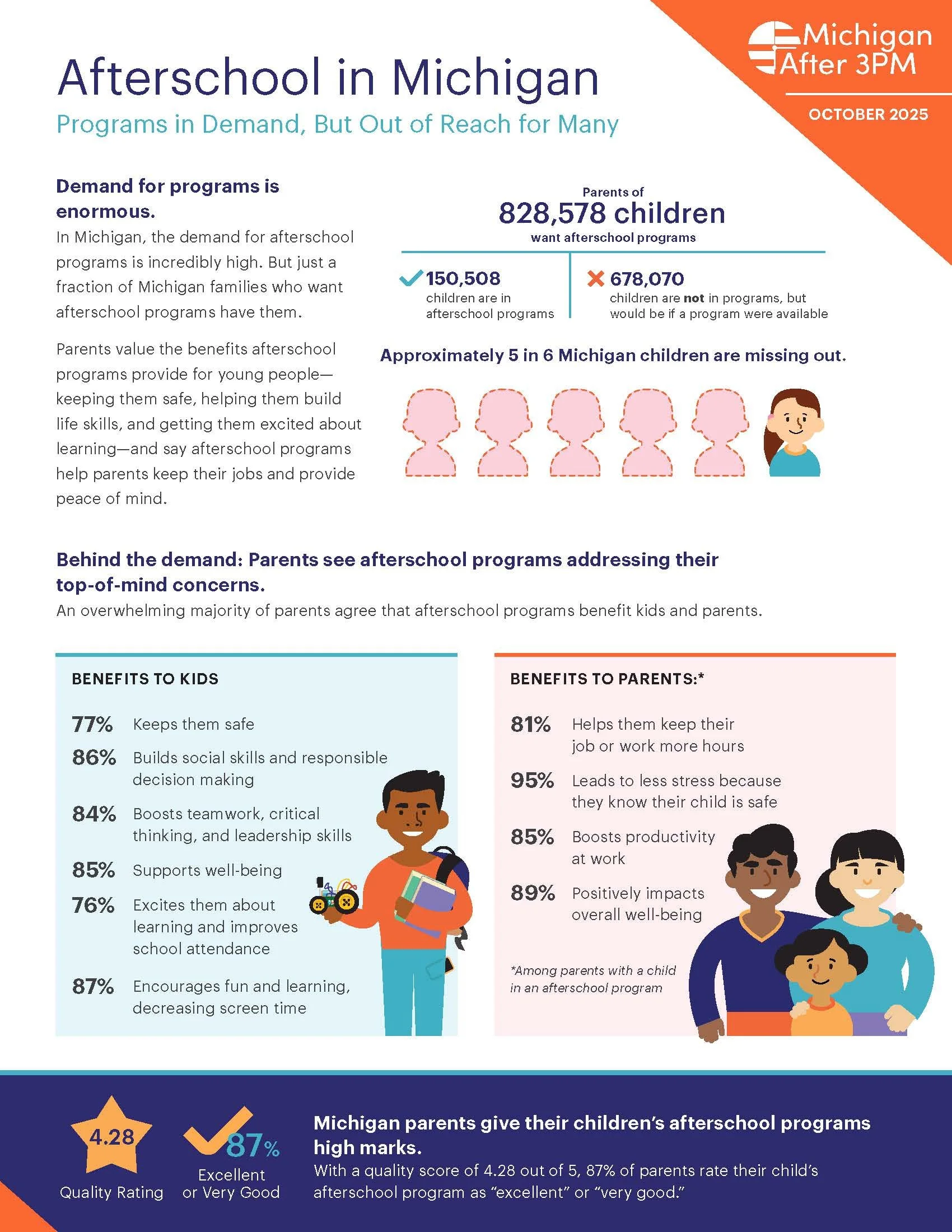
According to the newly released data, parents of 828,578 Michigan young people would like access to an afterschool program. Only 150,508 are currently enrolled, leaving approximately 678,070 young people without access who would participate if a program were available.

That means approximately five out of every six young people in Michigan whose parents want afterschool opportunities are missing out.

Families See the Value of Afterschool

The demand is not surprising. Michigan parents overwhelmingly recognize the role afterschool programs play in supporting young people’s learning, development, and well-being.

Among Michigan parents surveyed:

  • 87% said programs encourage fun and learning while reducing screen time.

  • 86% said programs build social skills and responsible decision-making.

  • 85% said programs support young people’s well-being.

  • 84% said programs strengthen teamwork, critical thinking, and leadership skills.

  • 77% said programs help keep young people safe.

  • 76% said programs increase excitement about learning and improve school attendance.

Parents whose young people are enrolled also reported significant benefits for their own families. Ninety-five percent said knowing their young person was safe reduced their stress, while 85% said afterschool programs improved their productivity at work. Eighty-one percent said access helped them keep their job or work additional hours.

Michigan families also gave their programs high marks. Eighty-seven percent of parents rated their young person’s afterschool program as “excellent” or “very good,” resulting in an overall quality score of 4.28 out of 5.

Too Many Families Face Barriers

Although families clearly value these opportunities, affordability, transportation, location, and program availability continue to prevent participation.

Michigan parents identified several common barriers:

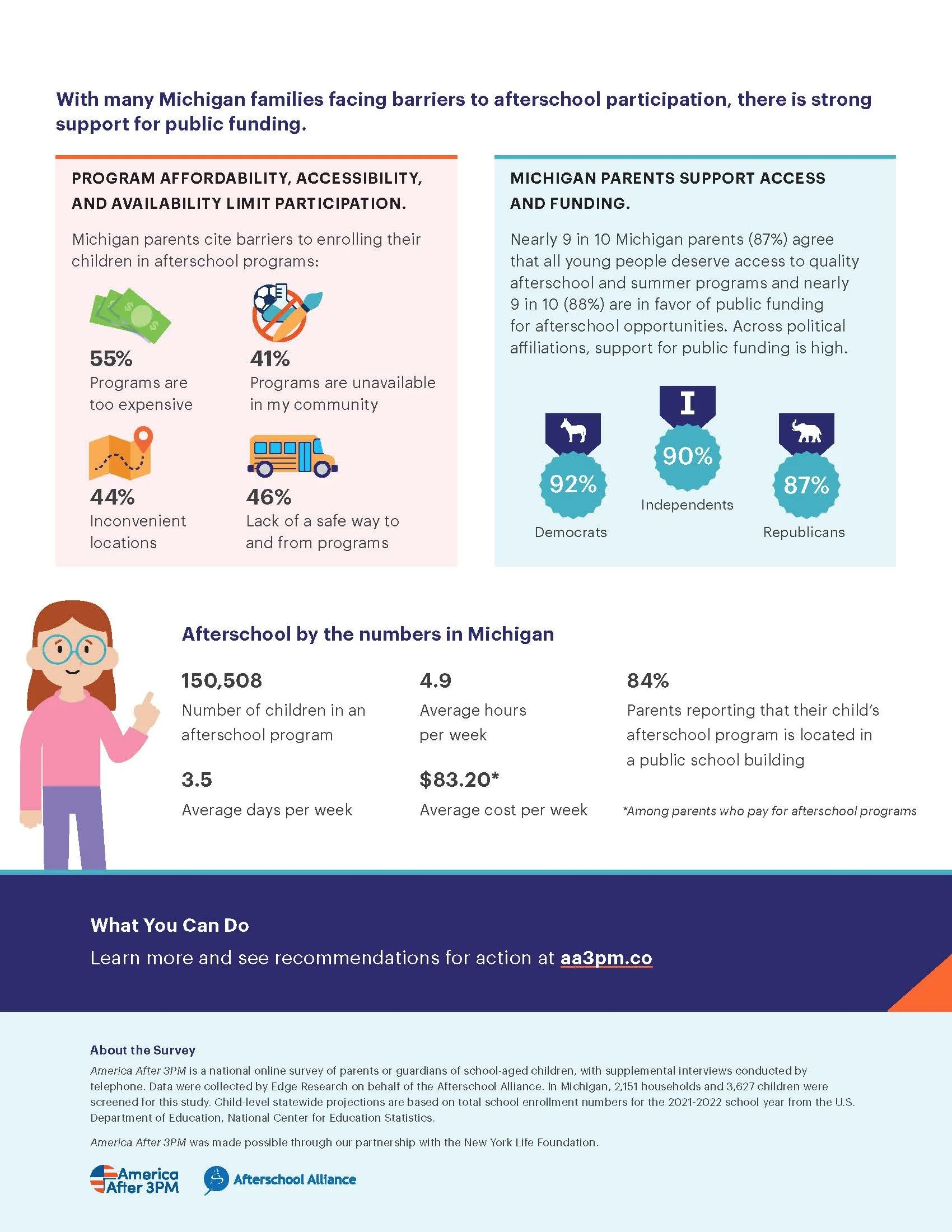
  • 55% said programs were too expensive.

  • 46% reported not having a safe way to travel to and from programs.

  • 44% said programs were located in inconvenient locations.

  • 41% said programs were unavailable in their community.

Among families who pay for afterschool care, the average weekly cost was $83.20. Young people enrolled in programs attended an average of 3.5 days per week for approximately 4.9 hours each week.

These findings show that the afterschool access gap is not caused by a lack of interest. Families want these programs. The opportunities simply are not available, affordable, or accessible enough to meet the need.

Strong Support Across Political Affiliations

Michigan parents are also united in their support for expanding access.

Nearly nine out of 10 parents, or 87%, agreed that all young people deserve access to quality afterschool and summer programs. Another 88% supported public funding for afterschool opportunities.

That support crossed political affiliations, including:

  • 92% of Democrats

  • 90% of Independents

  • 87% of Republicans

At a time when public conversations can feel increasingly divided, afterschool remains an issue with broad, bipartisan support. Michigan families recognize that these programs benefit young people, strengthen families, support the workforce, and contribute to healthier communities.

Michigan Must Meet the Demand

The 2025 America After 3PM findings provide a clear call to action. Michigan has hundreds of thousands of young people who would participate in afterschool programs if they could access them.

Meeting that demand will require sustained public investment, stronger transportation solutions, expanded program availability, and continued support for the professionals and organizations providing high-quality Out-of-School Time opportunities throughout the state.

Every young person deserves a safe and supportive place to learn, connect, grow, and belong outside of the traditional school day. Michigan families are asking for these opportunities. Now, our state must work together to make them possible.

America After 3PM is a national survey of parents and guardians of school-aged young people conducted by Edge Research on behalf of the Afterschool Alliance. In Michigan, the study screened 2,151 households representing 3,627 young people. The survey was made possible through a partnership with the New York Life Foundation.

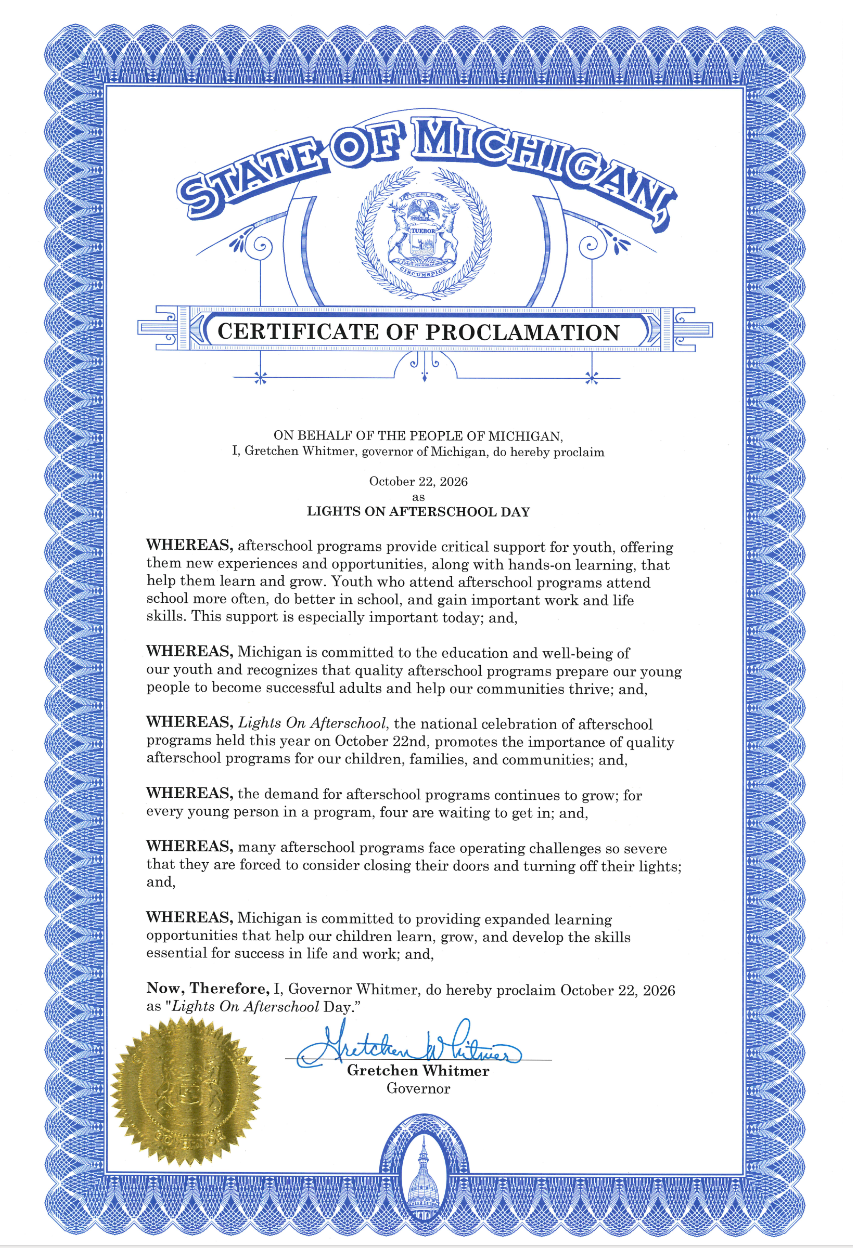
Governor Whitmer Proclaims October 23 as Lights On Afterschool Day in Michigan

Governor Gretchen Whitmer has proclaimed October 23, 2025, as Lights On Afterschool Day in Michigan, joining communities nationwide in celebrating the essential role of afterschool programs in helping young people learn, grow, and thrive.

Lights On Afterschool is a national celebration recognizing the power of afterschool programs to keep youth safe, support working families, and build stronger communities. In Michigan, the need and impact are clear. According to the 2025 America After 3PM report, 86 percent of parents say afterschool programs help their children build social skills and make responsible decisions, while 87 percent say they encourage fun and learning that reduces screen time. Yet, for every child enrolled in a Michigan afterschool program, five more would participate if one were available.

Governor Whitmer’s proclamation honors the dedication of afterschool professionals and partners who keep the lights on for Michigan youth. It also reaffirms the state’s commitment to investing in afterschool opportunities, reflected in Michigan’s $75 million allocation for out-of-school time programs in Fiscal Year 2026.

As programs, youth, and communities across Michigan flip the switch for Lights On Afterschool, we celebrate the creativity, resilience, and potential of every young person and the shared belief that when youth have access to quality afterschool programs, everyone benefits.

Michigan Commits $75 Million to Afterschool and Summer Learning Programs

Today marks a historic moment for Michigan’s youth, families, and communities. Governor Gretchen Whitmer and state policymakers have approved $75 million in state funding to expand access to quality afterschool and summer learning programs across Michigan.

This investment reflects a growing recognition that out-of-school time (OST) programs are essential infrastructure—not optional extras. Afterschool and summer programs provide young people with safe, engaging spaces to explore new interests, connect with caring adults, and build the skills that support success in school, work, and life.

The funding will help launch and sustain programs statewide, with a focus on communities where access to afterschool and summer opportunities has historically been limited. It builds on the state’s continued support for the Section 32n OST grant program, which has provided essential resources for local organizations to create and grow quality enrichment experiences for youth.

From STEM clubs to arts exploration, from youth leadership development to career readiness, Michigan’s OST programs help young people discover their passions and strengthen their sense of belonging.

The Michigan Afterschool Partnership applauds Governor Whitmer, the Michigan Legislature, and all the partners and advocates who made this milestone possible. This funding represents not just a financial investment, but a belief in Michigan’s youth—and the vital role afterschool and summer learning play in our communities.

MASP remains committed to supporting local programs, uplifting youth voices, and ensuring that every young person has access to opportunities that help them grow, lead, and shine.

State Budget Update: Urgent Advocacy Needed for 32n

Last night, Michigan lawmakers approved a one-week continuation budget to keep state government open while final negotiations on the FY26 budget continue. This stopgap measure buys time, but the real decisions that affect afterschool and summer learning are still on the table.

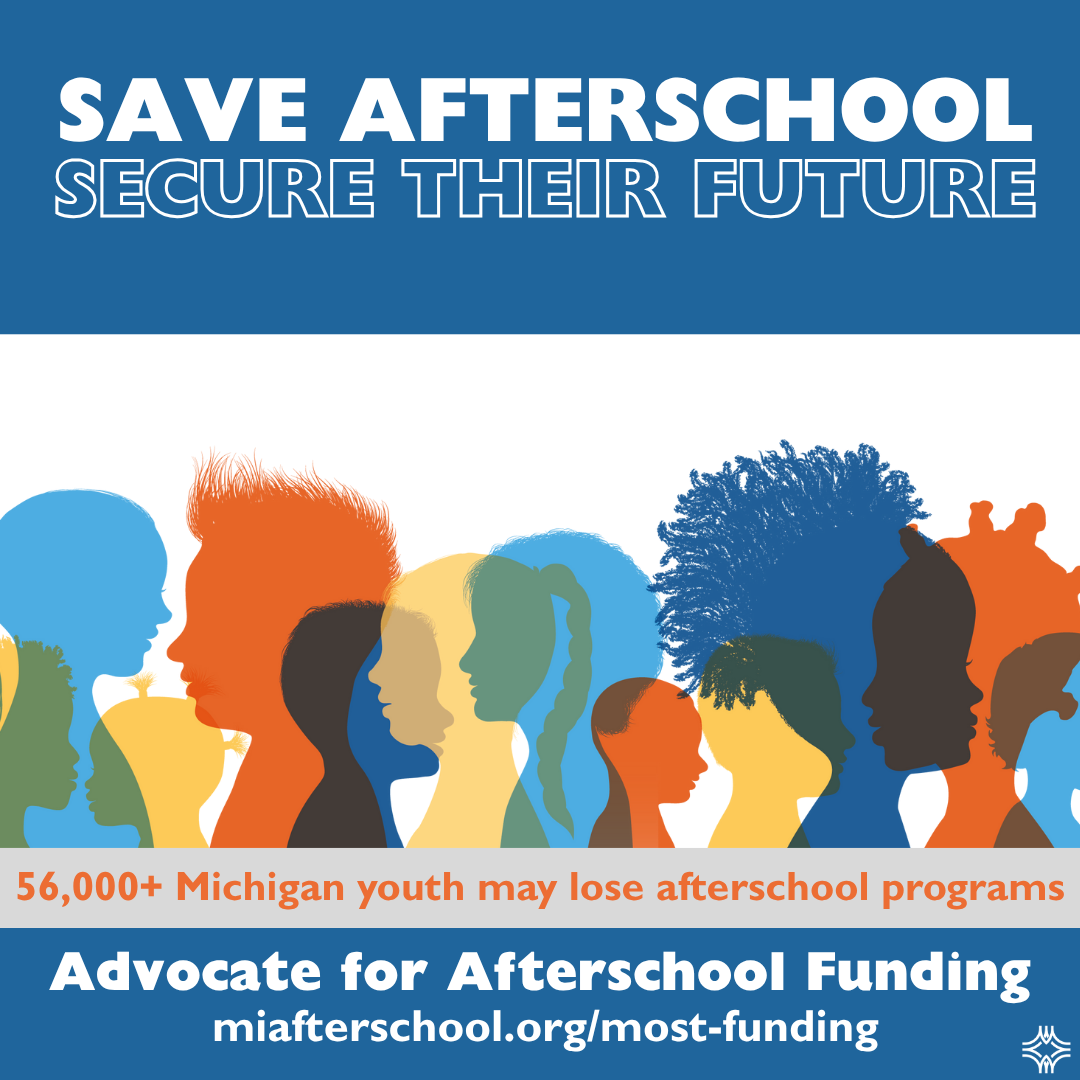
For OST programs, the priority is clear: protecting Section 32n funding. Without a strong commitment in the final budget, community programs could face shortfalls at a time when demand for afterschool and summer learning is higher than ever.

👉 The next few days are critical. Lawmakers are working through budget details right now, and they need to hear directly from you. Programs, parents, and partners must speak up to ensure 32n remains a priority.

What you can do:

  • Call or email your legislators today—let them know why 32n matters for your community.

  • Share stories of how OST programs support kids, working parents, and local schools.

  • Encourage partners to do the same—the louder our collective voice, the stronger our impact.

This is one of the most challenging budget cycles in recent memory. The time for advocacy is now.


Speak Up for Afterschool — Tools to Advocate for Public Funding

Now is a critical time to protect and grow funding for afterschool and summer programs. As legislators shape the next fiscal budget, your voice and advocacy matter more than ever. There is still time to advocate for continued 32n funding—and your outreach can make a real difference.

Join us for one of two hands-on webinar designed to help programs, partners, and community champions take action for out-of-school time funding in Michigan. We’ll walk you through ready-to-use advocacy tools to support state OST funding—including site visit guides, sample letters to legislators, social media templates, and outreach tools to engage youth and families and elevate your program’s impact.

Speak Up for Afterschool

Monday, August 11
9.00 a.m. - 10 a.m.
Virtual

Tuesday, August 12
Noon - 1 p.m.
Virtual

21st CCLC Funds Released to States, Including Michigan

We’re relieved to share that the U.S. Department of Education has officially begun notifying states—including Michigan—that their Fiscal Year 2025 21st Century Community Learning Centers (21st CCLC) grant awards have been processed.

This means the critical funding that supports more than 16,000 youth across more than 230 afterschool and summer learning program sites in Michigan is finally on its way to the Michigan Department of Education (MDE).

This long-awaited action comes three weeks after the Office of Management and Budget (OMB) abruptly halted the release of funds, sparking concern and uncertainty for programs, families, and youth across the country. The freeze threatened summer programming and left fall planning in question for hundreds of providers in Michigan.

Thanks to powerful advocacy from the field—including your voices, stories, and persistence—this funding freeze has been resolved. We’re especially grateful to Michigan Attorney General Dana Nessel for joining a 22-state lawsuit demanding immediate release of the funds, and to the many programs that contacted Congress, shared stories, and kept the spotlight on this issue.

What Happens Now?

  • State education agencies like MDE are now receiving their official 21st CCLC grant award notifications.

  • Once received, MDE can distribute funding to local programs—allowing sites to move forward with hiring, planning, and implementing high-quality programming.

We know the past few weeks have been stressful and disruptive. Thank you to every provider, parent, youth, and partner who stood up for Michigan’s afterschool community. Your advocacy made a difference.

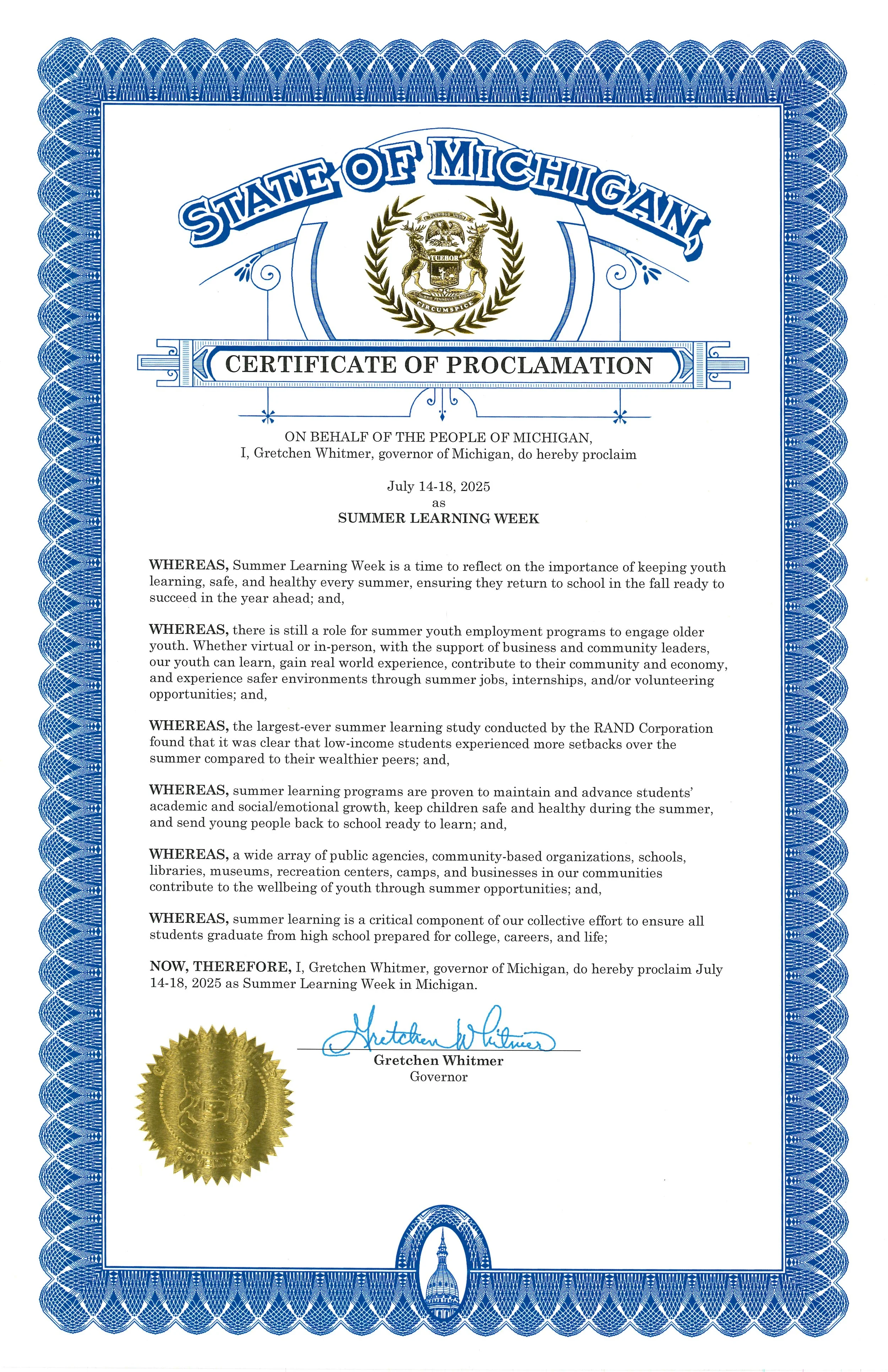
Governor Whitmer Proclaims July 14–18 as Summer Learning Week in Michigan

We’re excited to share that Governor Gretchen Whitmer has officially proclaimed July 14–18, 2025 as Summer Learning Week in Michigan!

This statewide recognition shines a spotlight on the vital role that summer learning programs play in keeping youth engaged, supported, and thriving during the months when school is out. From hands-on STEAM activities and literacy programs to youth employment and community service opportunities, summer learning helps young people continue to grow academically, socially, and emotionally.

The Michigan Afterschool Partnership (MASP) is proud to join partners across the state and nation in celebrating the impact of summer programs. When youth are learning, safe, and supported all year long, our communities grow stronger.

Read the full proclamation below!

21st CCLC Funding Freeze

Federal funding for afterschool and summer learning is under serious threat.

On July 1, states were to receive their 21st Century Community Learning Center (21st CCLC) funding for this year’s summer and upcoming school year afterschool programs. The Administration is withholding the funds, leaving states and programs and scrambling to find ways to keep programs running. The Office of Management and Budget has said it is reviewing 21st CCLC, and has provided no timeline or next steps. The funding for states was committed in the bipartisan FY25 funding bill passed by Congress and signed into law by the President on March 15, 2025.

Increased costs and growing demand make continued federal support more critical than ever. Now that the administration has released its proposal, it's up to Congress to decide what gets funded—and they need to hear from you.

Here’s how you can help:

Use the 21st CCLC Funding Freeze Advocacy Toolkit to speak up for afterschool and summer learning programs.

Your voice can help protect Michigan’s youth, working families, and community programs from devastating cuts.

Out-of-School Time Presentation at the House Appropriations Subcommittee on School Aid and Education

Michigan Afterschool Partnership Executive Director, Erin Skene-Pratt alongside Nicole Liggins, President at Guided Grace Family and Youth Services, Grant B. Hegenauer, Superintendent at Frankenmuth School District and Uriel Bath-Yahweh, 9th grade student from Downtown Boxing Gym presented on the importance of afterschool and the impact the funding for OST has on the youth in Michigan.

We Heart Afterschool

Michigan Afterschool Partnership delivered "We Heart Afterschool" cookies to state legislators to continue sharing the importance and value of afterschool programs to youth, families and communities in Michigan.

Thank you State Representative Phil Skaggs , State Representative Greg VanWoerkom , State Representative Will Snyder , State Representative Nancy DeBoer, State Representative Timothy Beson and Legislative Aide and scheduler for State Representative Tom Kunse !

Governor Whitmer Proposes $50 Million Ongoing Support for OST

Michigan Afterschool Partnership applauds Governor Gretchen Whitmer’s inclusion of a $50 million investment in out-of-school time programs in her 2024 - 2025 budget proposal.

Including this level of funding in our state’s budget is unprecedented; we are one of three states in the nation to offer families significant resources to support them through high quality out-of-school time programs.    

The Governor is following the evidence as decades of research point to out-of-school time’s impact on kids’ health, academic performance, overall well-being, and lifelong success. She’s responding to what families need too. Out-of-school time programs allow parents to have more consistent and stable employment, leading to higher earnings and financial stability.  

In collaboration with the state, partners, and out-of-school practitioners, Michigan Afterschool Partnership looks forward to doing our part to make Michigan a place where every child can succeed. 

Gov. Whitmer Announces Grants for Before- and After- School Programs

$50M in grants expands access to affordable, engaging before, after, and summer school opportunities for over 67,000 students at 780 locations across the state 

LANSING, Mich. – Today, Governor Gretchen Whitmer joined the Michigan Department of Lifelong Education, Advancement, and Potential in announcing $50 million in grants to before- and after-school programs. These grants will help increase access to before- and after-school and summer learning programs, helping more youth engage in enrichment activities outside of the regular school day hours while providing homework help and accelerated learning opportunities in literacy, math, and science, and offer additional support to working families knowing their children are safe.  

“Today, we are expanding access to before and after school programs for over 67,000 students at 780 locations across Michigan, ensuring every student gets the support they need to succeed,” said Governor Whitmer. “These programs help kids explore their interests, get extra academic support, and connect with their peers. They also make it easier for parents to work, knowing their kids are safe and cared for additional time outside of school hours. As a parent and as governor, I know that today’s investments will set more students up for success.” 

These grants will help provide educational programming in core subject areas, including, but not limited to, mathematics, reading, and science. Recipients can use funds to increase their enrollment capacity, accelerate learning, and reduce costs for participating families, helping to resolve the unmet demand for Out-of-School Time programming in Michigan. A total of 125 program proposals will be funded for the 2023-2024 program year to serve 31,000+ youth during the school year and an additional 36,000+ young people during the summer.    

“As a former educator and Senate Education Committee Chair, it's very clear to me how important before and after school programs are to students and their families,” said state Senator Dayna Polehanki (D-Livonia). “Funding before and after school programs help keep our children engaged scholastically and our communities safer. I look forward to securing even more wins for students in the future.” 

“Investing in Michigan students is an investment in our collective future,” said state Senator Kevin Hertel (D-St. Clair Shores). “Before- and after-school programming is not simply an extension of the school day, but provides young people with invaluable opportunities to explore, learn and grow. The $3.6 million awarded to the Macomb Intermediate School District will help expand these types of opportunities for Macomb County students, ensuring they have the support they need to be successful both inside and outside of the classroom.” 

“Before- and after-school programs improve and enrich the educational experiences of our students. Wayne Regional Education Services Agency is receiving over $1.2 million in funding from this grant, which is a direct investment in Downriver’s future workforce,” said state Rep. Jaime Churches (D-Wyandotte), vice chair of the House Education Committee. 

“Kids in communities of color and low-income neighborhoods too often miss out on enrichment opportunities. Ironically, those programs can help them the most,” said state Rep. Kimberly Edwards (D-Eastpointe), member of the House Education Committee. “These grants are win-wins, helping close educational and after-school care gaps. I am excited Michigan is further investing to ensure all Michigan students can access the support they need to succeed, especially in Detroit and Macomb.” 

According to research conducted by the Afterschool Alliance, more than 751,000 children in Michigan lack access to out of school time programming. Furthermore, the Michigan Afterschool Partnership found that there is a disproportionate undersupply of out of school time providers in Michigan’s predominately Black and low-income communities. 

Data from the Afterschool Alliance also reveals that lack of program availability, high costs, and transportation issues produce the most significant obstacles to OST programs for Michigan parents. These grants will help reduce barriers and enable more parents to enroll their children in expanded learning programs.  

“Children enrolled in out-of-school time programs are more likely to experience improvements in their performance at school, improvement in behavior, and have a higher earning potential as adults,” said Erin Skene-Pratt, Executive Director of the Michigan After School Partnership. “These programs also help parents sustain employment and provide parents with peace of mind knowing their children are safe and cared for before and after school. The benefits of out-of-school time programming are substantial and increasing access to these programs is crucial for children and families in Michigan.” 

“Celebrating this $50M in grants is part of a greater overall increased recognition of the importance afterschool and summer learning programs play in our overall P-20 education system for our children and youth,” said Richard Lower, Director of Preschool and Out-of-School Time Learning at the Michigan Department of Lifelong Education, Advancement, and Potential. “Governor Whitmer and legislative leadership have also invested another $171M in other out-of-school time program grants for this year, including the tutoring program MI Kids Back on Track. Together, these investments position more Michigan kids to meet their academic goals and thrive in school and beyond.” 

“As a grantee of the 32n OST Grant funding, our organization was able to reach the most vulnerable population of children. We were successful in delivering quality summer enrichment programming in the areas of literacy, science, and math adding diversity and inclusion as a theme to bring awareness and unity. Youth were able to participate in civic engagement through a violence prevention program that promoted leadership and built confidence,” said by Nicole Liggins, CEO of Guided Grace FYS in Saginaw. “Without these funds, youth would not have been exposed to this type of programming or afforded these social interactive learning opportunities and/or experiences.” 

The following programs are receiving awards to serve five or more program sites. The full list of sub-awardees can be viewed on the Out-of-School Time Programs’ website at Michigan.gov/MiLEAP.